Öko-otthonok
English Only! Download PDF The problem

Policy Relevance
Good Experience
The Problem
In Europe 40% of our energy use is consumed in buildings, more than in industry or transport. That is a lot. It is too much.
According to the European Commission, building energy use contributes approximately 40% of Europe´s energy needs while traffic contributes 32% and industry 28%. Energy use per household has remained more or less constant and the growth in final energy use is related to the increase in number of households.
The building sector − i.e. residential and commercial buildings − is the largest user of energy and CO2 emitter in the EU Community but it is also the sector where the added value of common efforts in energy saving is significant. Up to 27% of the energy use in households and 30% used in commercial buildings could be saved in a cost effective way by using technology that exists or has already been improved. It is estimated that more than one fifth of present energy consumption of energy (up to 35-45 Mt of CO2) can be saved with the introduction of more efficient standards in new construction and rehabilitation of existing buildings.
Furthermore, the building sector is crucial in meeting energy and climate objectives at the least possible cost to individuals and society in all countries. Reduction of energy consumption in the building sector constitutes an important part of the measures needed to reduce greenhouse gas emissions and comply with the Kyoto Protocol and with the 20-20-20 European commitment. The EU Green Paper for Energy Efficiency estimates that by 2020, 41 MTOE (million tonnes of oil equivalent) can be saved by improving heating and cooling in our buildings.
If we can improve the environmental efficiency of our homes, then we have two huge benefits. One is the benefit to the planet, on a global scale. The other, on a more specific and personal scale, is to hugely reduce the costs of energy. Indeed, for many, many people, energy poverty is going to be a major problem. [ ^ Back to Summary ]
The European building stock is aging rapidly. In most EU member states, between 70-90% of buildings were constructed at least 20 years ago.
Energy consumption per square meter varies enormously within the European Union: whilst new buildings can need less than 3 to 5 litres of heating oil or equivalent per square meter floor area a year, existing building stock consumes, on average, about 25 litres, some buildings even up to 60 litres.
There is a stock of 160 million buildings in the EU. The present rate of construction of new buildings is below 2%/year in all major European countries. These figures extend the hope of having a truly energy-efficient building environment far beyond one century and probably closer to two centuries if action is limited to new buildings. For that reason focus is needed on the renovation of existing buildings.
In the EU 15, half of the energy used in buildings could be saved through simple and effective measures, such as better insulation. The story in new Member States is even worse. As in the EU 15, new Member States use over 40% of their energy in buildings. However, CO2 emissions per square metre of floor space are 25% higher, due in large part to lower levels of thermal insulation. This means more waste but also, a greater opportunity for saving energy.
Simple and cost effective energy efficiency measures like better insulation and double glazing could deliver savings equivalent to 500 million cubic meters of gas per day. In many existing buildings, there is no insulation at all or only 25-50mm. Today, insulation thicknesses of between 300 to 600mm are used in new low energy buildings and between 175 and 350mm in new standard buildings. Usually, there are also many thermal bridges in old buildings due to gaps in the insulation layer. In some cases, the initial insulation work was not carried out carefully enough. In other cases, thermal bridges have arisen over the years, e.g. by boxes and other items put on the roof insulation, or by spotlights and other installations penetrating the insulation.
In many of the new EU Member States, renovating the existing building stock is urgently required. Some Member States have made promising progress in improving their building efficiency, but the majority still have an enormous untapped potential for improvement.
Building renovations are needed for social reasons just as much − most of the residential building stock is in need of urgent repair − as for economic or environmental reasons:
- Economic: An appropriate energy efficiency retrofit programme would create 1.7 billion EURO a year in energy savings − substantially offsetting the overall annual renovation costs for existing buildings.
- Social: Retrofit programmes would not only create between 150,000 and 230,000 new jobs (EURIMA estimate) but would radically improve housing conditions and protect vulnerable sections of society from future increases in energy prices.
- Environmental: Carbon dioxide emissions would be reduced by 14 million tonnes a year and air pollution could be reduced dramatically.
Policy Relevance
The 20% energy savings objective, as well as the 20% targets for renewable energy and CO2 reduction set for 2020 by EU, depends to a large extent on improving the energy performance of buildings.
In January 2007, the Commission proposed a comprehensive climate and energy package containing targets of 20-20-20% reduction of energy consumption and greenhouse gas emissions, and increased share of renewable sources by 2020. The package, approved by the EU´s 27 leaders at a summit in Brussels in December 2008, introduces a series of legally-binding measures designed to reducing emissions to 20% below their 1990s levels by 2020. It also includes provisions for improving energy efficiency by 20% and for making the EU produce 20% of its energy from renewable sources such as solar and wind power by 2020. The reduction of energy consumption can clearly make a significant contribution in achieving these targets. The building sector provides many cost-efficient opportunities for action, while at the same time contributes to the welfare of EU citizens. [ ^ Back to Summary ]
The EC Action Plan for Energy Efficiency ("Realizing the Potential", Oct. 2006) identifies energy efficiency in the building sector as top priority.
On October 19, 2006 the European Commission published an ambitious Action Plan for Energy Efficiency (EC 2006). The Action Plan identifies energy efficiency in the building sector as a top priority.
The EPBD (European Energy Performance in Buildings Directive) is considered as playing a key role in realising the saving potential in the building sector. In its Energy Efficiency Action Plan, the European Commission proposes that Europe should move to very low energy (or Passive House) standards by 2015. [ ^ Back to Summary ]
The EPBD Directive is the framework for EU member state legislation on building energy standards and energy labelling.
The Energy Performance of Buildings Directive (EPBD) was adopted in 2002 to help the EU meet its climate commitments under the Kyoto Protocol. The European Energy Performance in Buildings Directive (EPBD) came into force on January 4th 2003. January 4th 2006 was the official deadline by which the 25 Members States had to transpose the Directive into national law. Member States could, because of a lack of qualified and/or accredited experts, have an additional period of three years for full application: January 2009.
The EPBD Directive addresses both existing buildings and new constructions. The EPBD´s main objective is to promote the cost effective improvement of the overall energy performance of buildings. Its provisions cover energy needs for space and hot water heating, cooling, ventilation and lighting for new and existing, residential and non-residential buildings. Most of the existing provisions apply to all buildings, regardless of their size and whether in residential or non-residential use. Some provisions only apply to specific building types.
The Directive combines, in a legal text, different regulatory (such as the requirement for Member States to set energy performance requirements for new and large existing buildings that undergo major renovation) and information-based instruments (such as energy performance certificates, inspection of heating and air-conditioning requirements). The EPBD does not fix EU-wide levels, but requires Member States to lay down concrete requirements and relevant mechanisms. Every country has its own building codes, traditions and climate conditions. In cold and cool regions, the buildings must be optimised and insulated to reduce the consumption of energy for heating whereas in hot and warm regions the purpose of insulation is to reduce the loss of energy from air-conditioning.
The definition of very low energy buildings varies significantly across Europe even though the EPBD (Energy Performance of Buildings Directive) gives guidelines for the calculations. The variation exists not only in terms of the absolute level of energy consumption in a low energy building, but also the deviation from the minimum requirements as stated in national Building Regulations.
In some countries there is a special situation as the legislation regarding minimum requirements for building energy performance is defined at a regional level. This means that definitions for very low energy buildings may differ from region to region. These countries are: Belgium, Spain, Italy, and Romania. There was a delay in the EPBD´s implementation, but 22 Member States now declare full transposition (under evaluation by the Commission).
As many member states failed to implement the legislation on time, the European Commission decided to propose a recast of the directive in November 2008 to tap into the potential for improvements.
Main discussions in the EPBD recast:
- when buildings undergo major renovation, that minimum energy performance requirements are met by all existing buildings and not only buildings with an area greater than 1000m2,
- introduction of minimum energy performance requirements per square meters
- a strengthened role for the "energy performance certificate"
The European Parliament adopted its first-reading position on April 23rd 2009 on the directive recasting. In the same document the Parliament states that Member States shall ensure that all new buildings are at least "net zero energy buildings" by December 31st 2016 at the latest. They shall set targets for the minimum percentage of buildings which shall be, by 2015 and by 2020 respectively, net zero energy buildings, measured as a percentage of the total number of buildings and as a percentage in relation to the total useful floor area.
At Member State level most of the definitions of low energy buildings are intended or targeted at new buildings. Examples of very low energy buildings with clearly defined requirements in the European Member States are:
- German Passive House,
- the French Effinergie®,
- the Swiss Minergie® and MinergieP® and
- The Danish Low Energy
The Passive House is generally the best-known type of very low energy since it is the oldest concept having been devised in Germany in the 1990s. It is generally recognised that the requirement for calling a building passive is that it lives up to the standards developed by the German Passive House Institute. Thus, most passive houses are found in Germany, Switzerland and Austria. A Passive House is a well-insulated building which maintains a comfortable interior climate, using the free “passive” energy from body heat, solar gains and appliances as the key energy providers for heating. In Europe there is a stock of 160 million buildings and the present rate of construction of new buildings is below 2%/year. The biggest challenge is certainly on existing buildings. Too often, cost-effective energy savings are simply not initiated or building owners and their advisors forget to include vital energy-efficient components when renovating their house. Available construction products and installation technologies can drastically improve the building´s energy performance and so reduce its energy consumption.
In some cities, policy-makers are now going further, planning entire districts that have a variety of measures combating greenhouse gas emissions in ways that facilitate lower per capita energy consumption, using means such as sustainable urban transport and low energy housing. New technologies for energy efficiency and renewable resources, such as solar or wind energy and alternative fuels are also important in the so called “green districts”. [ ^ Back to Summary ]
Good experience
KlimaHouse Agency
The Government of Upper Austria has adopted a leading position regarding efficient construction. The Klima House agency annually sets the limit value of annual energy consumption per unit of land for new residential construction . Contacts: Norbert Lantschner, direttore norbert.lantschner@agenziacasaclima.it | tel +39 0471 062 140. [ ^ Back to Summary ]
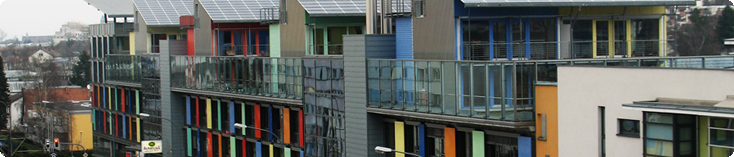
Green buildings in Kronsberg, a sustainable district designed and built in the south of Hannover.
The City of Hannover has a long tradition in 'green building'. On the occasion of EXPO 2000, a sustainable new district was designed and built south of Hannover, 'Kronsberg'. The target was to emit 80% less CO2 compared to conventional new constructions by means of:
- low Energy House (LEH) construction methods with quality assurance monitoring,
- a district heating network, supplied from CHP plants,
- electricity saving programmes,
- n°2 wind turbine generators.
City of Hamburg, European green capital 2011.
The European Commission has long recognised the important role that local authorities play in improving the environment, and their high level of commitment to genuine progress. The European Green Capital Award was conceived as an initiative to promote and reward these efforts. Starting in 2010, one European city is selected each year as the European Green Capital of the year. Hamburg has been nominated European Green Capital Award 2011. Hamburg is one of the ten biggest cities in Europe. The Port of Hamburg on the river Elbe is Europe´s second largest in terms of number of containers handled. Hamburg has set ambitious climate protection goals such as reducing its CO2 emissions by 40% by 2020 and by 80% by the year 2050. CO2 emissions per person have been reduced by about 15% when compared to 1990, with annual energy savings of some 46,000 MW, a major achievement for a big city. Contact: Klaus de Buhr, Ministry Urban Development and Environment, email Kluas.debuhr@bsu.hamburg.de | tel.+4940 [ ^ Back to Summary ]
Data and Indicators
- The saving energy potential in buildings is estimated at 28%, which in turn can reduce total EU final energy use by around 11% (Wuppertal Institute 2005).
- Energy efficiency measures such as insulation in all European buildings would save 460 million tonnes of CO2/year, the equivalent of 3.3 million barrels of oil per day and would create 530,000 jobs in Europe (Ecofys, Europe's energy consultancy).
- By 2007, more than 8,000 buildings were successfully constructed in Europe to a low energy standard; with very positive feedback from their users.
Link and References
- By 2007, more than 8,000 buildings were successfully constructed in Europe to a low energy standard; with very positive feedback from their users. Download the document
- EC Action Plan for Energy Efficiency Realising the potential, Oct. 2006 European Commission. Download the document
- The European website on energy efficiency of buildings. Link: ec.europa.eu/energy/efficiency/buildings/buildings_en.htm
- The European Portal for Energy Efficiency in Buildings. Link: www.buildup.eu
- Eurima, European Insulation Manufacturers Association. Link: www.eurima.org
- European Green Capital Award. Link: ec.europa.eu/environment/europeangreencapital/about.html